


Views: 0 Author: Site Editor Publish Time: 2025-10-14 Origin: Site


High-Angle Bevel Laser Cutting: An Innovative Solution for High-Precision Machining
Introduction of the fiber laser cutting machine:
In modern manufacturing, laser cutting has become a core technology in metalworking due to its high efficiency, high precision, and low thermal impact. However, traditional laser cutting primarily targets vertical or small-angle bevels (<30°). When cutting large-angle bevels (45°-90°), problems such as optical path deviation, focus drift, and slag accumulation can occur, resulting in reduced cutting quality.
To address this issue, high-angle bevel laser cutting has emerged. Leveraging advanced CNC technology, intelligent optical compensation, and process optimization, it achieves high-precision, smooth high-angle cutting. It is widely used in demanding industries such as oil pipelines, aerospace, and automotive manufacturing.
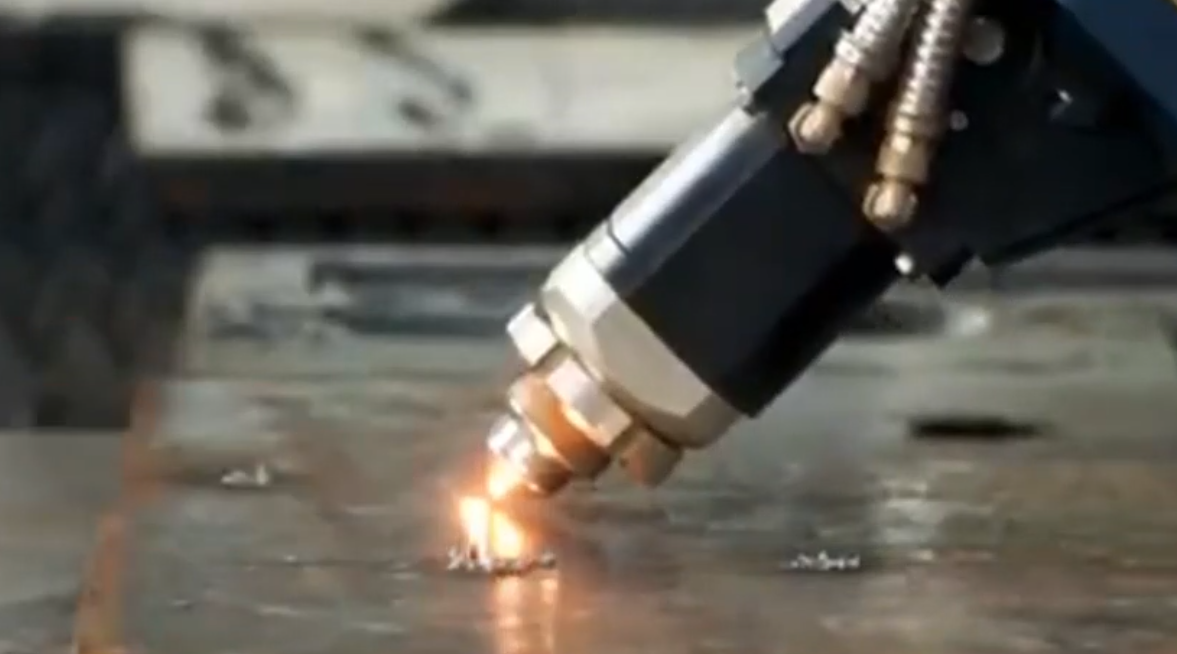 Applications of High-Angle Bevel Laser Cutting
1.Oil/Gas Pipeline fiber laser Welding Bevels
Pipeline joints require precise, high-angle bevels (30°-60°). Traditional milling is inefficient, while laser cutting allows for single-step formation, improving weld quality.
2.Automotive/Aerospace Structural Parts
Complex components such as aircraft wing ribs and body frames require precise, high-angle bevel cutting to reduce weight and enhance structural strength.
3.Military/Ship building Area
High-angle cutting of thick plates (>20mm) is prone to thermal deformation due to traditional methods. Laser cutting reduces the need for subsequent processing.
4.High-end Industrial Equipment
For equipment requiring high-precision bevels, such as wind turbine towers and chemical reactors, laser cutting ensures excellent fit accuracy.
Technical Challenges and Solutions of the Fiber laser Cuting machine
1. Optical Path Deviation and Focus Compensation (Key Technology)
When cutting at large angles, the oblique incidence of the laser beam can cause the effective focus position to shift, affecting the energy density distribution.
✅ Solution:
Dynamic Focus Tracking Technology: A built-in sensor in the cutting head adjusts the focus in real time, ensuring that the laser is always focused at the optimal cutting position.
Bevel Head: A rotatable cutting head (±45° or even higher) maintains the laser beam perpendicular to the workpiece surface.
2. Slag Accumulation and Gas Control
When cutting on an inclined surface, molten metal tends to accumulate downward due to gravity, resulting in rough cut surfaces or dross.
✅ Solution:
Optimize assist gas (O₂/N₂) pressure: Adjust the gas pressure based on the angle to ensure effective slag removal.
Multiple airflow design: Some high-end cutting heads use dual airflow paths, with high-pressure gas from the upper side to remove slag and low-pressure gas from the lower side to ensure stable cutting.
3. Matching cutting speed and power
The larger the angle, the greater the effective laser area and the lower the energy density. Parameters must be adjusted to avoid incomplete cutting or excessive ablation.
✅ Solution:
Intelligent parameter database: Automatically matches the optimal power and speed combination based on different materials (carbon steel/stainless steel/aluminum) and angles (30°/45°/60°).
Adaptive energy control: Real-time laser power adjustment ensures uniform cutting across large angles.
Advantages of large-angle bevel laser cutting
Comparison | Traditional cutting (plasma/milling) | High-angle laser cutting |
Accuracy | ±0.5mm | ±0.1mm |
Surface roughness | Ra 6.3-12.5μm | Ra 1.6-3.2μm |
Heat-affected zone | Wide (easily deformed) | Extremely narrow |
Processing efficiency | Low speed, requires multiple passes | single-shot forming |
Fiber Laser Cutting Machine Case Study: Application Results at an Aerospace Company
Requirement:
Titanium alloy aircraft structural parts (12mm thick) requiring 60° bevel cutting to ensure Ra < 3.2μm.
Traditional method: Milling + polishing, 45 minutes per part, 85% yield.
Fiber Laser Cutting Solution:
Using a 20kW fiber laser with dynamic focus compensation technology.
Each part takes 8 minutes, yield increases to 98%, and post-processing costs are reduced by 30%.
Future Development Trends of Laser Cutting Machines in Thick Plate Cutting
1. Higher Angle Cutting (>60°): A more flexible cutting head design enables cutting at extreme angles.
2. AI Real-Time Optimization: Combined with machine vision, automatically detects and adjusts cutting parameters, reducing manual intervention.
3. Ultra-thick Plate (50mm+) High-Angle Cutting: The widespread use of ultra-high-power lasers (30kW+) will drive advancements in thick plate bevel cutting.


