


Views: 0 Author: Site Editor Publish Time: 2026-10-01 Origin: Site


Metal fabrication equipment investment forces a tough choice between operational versatility and uncompromising production throughput. Scaling tube production creates significant operational friction on the shop floor. Fabricators eventually hit a bottleneck where outsourcing becomes too expensive to maintain margins. However, investing in the wrong in-house laser architecture creates new problems. You risk stranded capacity, excessive changeover downtime, or inefficient floor space utilization. We evaluate these competing technologies strictly on verifiable production data. You must analyze your sheet-to-tube ratios and workflow implications before making a purchase. A combination system offers distinct advantages for specific environments, while a dedicated pipe system serves entirely different production goals. Understanding your exact operational requirements prevents costly capital misallocations. We will break down the exact metrics you need to track, from material handling constraints to changeover penalties, ensuring your next machine aligns perfectly with your actual production mix.
Versatility vs. Capacity: Combination machines consolidate floor space and reduce initial CapEx for high-mix, low-volume environments, but inherently sacrifice simultaneous sheet and tube processing.
The Changeover Penalty: The hidden cost of combo machines lies in changeover downtime; frequent switching between flat and rotary cutting severely degrades overall equipment effectiveness (OEE).
Throughput and Automation: A dedicated tube laser cutting machine is essential for continuous, high-volume tube runs, offering advanced bundle loading, automated part sorting, and specialized chuck systems that combo machines lack.
Decision Metric: The tipping point for investment relies on an objective time-study of your current production mix—typically, if tube processing exceeds 30-40% of your total laser cutting hours, or involves highly variable wall thicknesses and complex profiles, a dedicated system becomes financially viable.
You cannot make an informed equipment decision without establishing baseline metrics. Fabricators often rely on gut feeling rather than hard data when purchasing machinery. This approach leads to mismatched equipment and stranded capital. You must define your success criteria based on actual shop floor realities. We need to measure exact production hours. We need to categorize material types accurately. We must track the physical movement of material through your facility.
Start by auditing your current production hours. Separate the time dedicated to flat sheet processing from structural tube and pipe work. Pull the last six months of production data from your ERP system. Look specifically at spindle time or active cutting time, not just clocked job hours. Calculate the exact percentage of machine time spent on each category. This ratio forms the absolute foundation of your equipment strategy.
You must also forecast your future production mix. Analyze your sales pipelines and talk to your estimating department. Review historical outsourcing records to see exactly how much tube work you currently send to third-party vendors. Look for anticipated shifts in product design. If your engineering team plans to replace welded sheet metal assemblies with slotted tube frames to reduce assembly time, your tube volume will spike. Project these changes over a three-year horizon to ensure the machine you buy today fits your needs tomorrow.
Audit the specific geometries you currently process. Standard round and square tubes require basic handling and standard chucks. Complex open profiles demand advanced chuck capabilities. Angle iron, C-channel, and asymmetrical extrusions present unique gripping challenges that basic rotary attachments cannot handle. Document every profile type your shop processes, noting the maximum dimensions and weight per foot.
Analyze the frequency of wall thickness variations. Your production runs dictate required laser power and focal adjustments. Thick-walled structural steel requires higher wattage, slower rotational speeds, and robust assist gas delivery. Thin-walled aluminum tubes require high-speed rotational capabilities and rapid piercing routines. Document the minimum and maximum wall thicknesses across all active jobs. This data directly influences your machine specifications, particularly the laser source and cutting head selection.
Changeover downtime drains profitability directly from your bottom line. Transitioning a combination machine from sheet to tube mode requires physical labor and machine downtime. Operators must remove the flat cutting slats or pallets. They must engage and calibrate the rotary chuck. They must align the tailstock. They must load the tube material manually. Finally, they must zero the axes, run a calibration routine, and load the new cutting program.
Quantify this lost time accurately. A typical changeover takes between 20 and 45 minutes depending on the machine design and operator skill. If you switch modes twice a day, you lose up to an hour and a half of active cutting time. Multiply these lost machine hours by your standard shop rate. The annual labor cost and lost revenue associated with frequent changeovers often justify a completely different equipment approach.
Combination architecture attempts to solve two problems with one footprint. These systems integrate a rotary axis into a standard flatbed frame, usually mounting the chuck on the side or extending it past the main cutting bed. They offer distinct benefits for specific operational models. However, they also introduce inherent limitations regarding throughput and material handling. You must understand both sides to evaluate their utility for your shop.
Footprint efficiency stands out as the primary advantage. Job shops often operate in constrained facility layouts where every square foot matters. A sheet and tube laser cutting machine consolidates two distinct processes into one work cell. You save valuable square footage. You avoid the logistical headache of routing materials between separate departments, keeping your flat and rotary cutting centralized.
Initial capital expenditure remains lower. Purchasing a single combination unit requires less upfront capital than buying two specialized machines. This lower barrier to entry appeals to growing fabrication shops. It allows them to bring outsourced tube work in-house without overextending their credit lines or taking on excessive equipment debt.
These systems excel in high-mix, low-volume environments. They handle prototyping efficiently. If you run highly variable production schedules, versatility matters more than raw speed. You can cut flat brackets in the morning. You can process the structural frame in the afternoon. This flexibility supports custom fabrication workflows perfectly, allowing a single operator to build complete assemblies from one workstation.
You must acknowledge the concept of lost capacity. A combination machine cannot perform both functions simultaneously. While the rotary attachment runs, the flatbed sits idle. While you cut flat sheets, the tube chuck does nothing. You effectively sideline half of your machine's capability at any given moment. If you have enough work to keep both a flatbed and a tube laser busy, a combination machine will immediately become a bottleneck.
Material handling presents another significant bottleneck. Combination machines typically rely on manual or semi-manual tube feeding. Operators must load each tube individually. They must align the material by hand, secure the chuck, and monitor the cutting process. This manual intervention prevents continuous operation. It increases operator fatigue and introduces alignment errors, especially on heavier materials.
Physical constraints limit processing capabilities. The machine enclosure restricts maximum tube length. The lighter-duty chuck design limits maximum tube weight and diameter. You cannot process heavy structural beams on a side-mounted rotary attachment designed for thin-wall tubing. These limitations restrict the types of jobs you can accept and process efficiently.
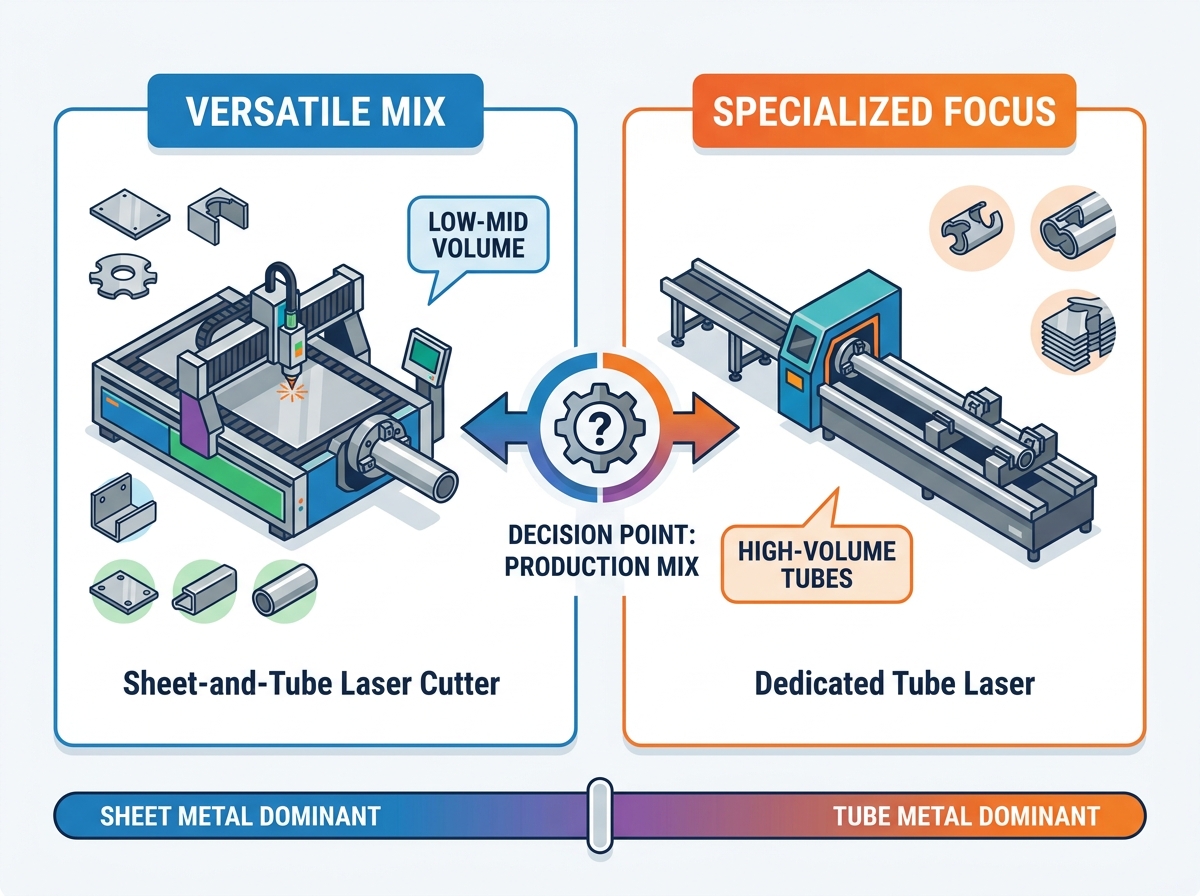
Specialized pipe and profile lasers utilize a fundamentally different architecture. Engineers design these systems specifically for continuous rotary processing. They eliminate the compromises found in combination units. These machines focus entirely on speed, precision, and automated material handling to drive down the cost per part on high-volume runs.
Automation drives throughput. A dedicated tube laser cutting machine integrates seamlessly with advanced material handling systems. Bundle loaders accept entire bundles of raw tubing directly from a forklift. The system automatically separates tangled tubes using singulation mechanisms. It measures the length of each tube and feeds them into the cutting zone one by one without operator intervention.
Step loaders offer another automated feeding option for heavy or asymmetrical profiles that cannot be bundled. These systems drastically reduce manual operator intervention. The machine runs continuously. Automated unloading systems catch finished parts. They transport them out of the enclosure safely using motorized conveyors. This level of automation enables true lights-out manufacturing capabilities, allowing the machine to run unattended during off-shifts.
Dedicated systems excel at processing complex profiles. They handle round, square, and rectangular tubes effortlessly. More importantly, they process open profiles like angle iron and C-channel with high accuracy. Specialized chucks grip asymmetrical shapes securely. They maintain perfect centerlines during rapid rotation, preventing the profile from twisting or deflecting under its own weight.
Multi-chuck systems represent a major technological leap. Traditional two-chuck systems leave a long un-cuttable dead zone at the end of the tube, resulting in significant material waste. Advanced three-chuck or four-chuck systems pass the material entirely through the cutting zone. They support the tube on both sides of the laser head. This minimizes vibration, maintains tight tolerances, and reduces material waste significantly.
Integration of 3D cutting heads expands capabilities further. These articulating heads tilt to create precise bevels. They perform complex weld prep directly on the machine. This eliminates secondary machining operations like manual grinding or milling. You deliver parts ready for immediate robotic welding, streamlining your entire downstream assembly process.
Automated part sorting transforms downstream workflows. Dedicated machines feature programmable outfeed systems. They route finished parts to specific bins or conveyors based on the nesting program. You can sort parts by job number, material type, or subsequent routing steps automatically. This eliminates manual sorting labor and prevents mixed batches from reaching the welding department.
Scrap management happens without interrupting the cutting cycle. Short offcuts drop onto dedicated scrap conveyors located beneath the cutting zone. The machine expels them into a separate hopper outside the enclosure. The primary cutting operation never stops. This continuous material flow maximizes overall equipment effectiveness and keeps the work area clean and safe.
Comparing these two technologies requires a structured approach. You must evaluate them across critical operational lenses. Features only matter if they translate into measurable outcomes on your shop floor. We will break down the technical differences that directly impact daily production, facility layout, and part quality.
Facility layout dictates equipment choices heavily. A dedicated tube laser requires a massive linear footprint. You must account for the machine frame, the bundle loader, and the outfeed conveyor. A system processing 24-foot tubes might require 60 feet of linear floor space. You need clear forklift access along the entire loading zone to stage raw material bundles safely.
Combination units offer a wider, consolidated footprint. They resemble standard sheet metal laser cutting machines with an extended side enclosure. They fit into traditional rectangular work cells more easily. However, you still need clearance to load tubes into the side attachment. You must map these footprints against your existing shop layout carefully, accounting for material staging, operator walkways, and scrap removal paths.
Machine rigidity directly impacts cutting speed and edge quality. Heavy-duty, vibration-dampening frames define dedicated tube lasers. Rotating heavy steel tubes creates immense centrifugal force. A rigid frame absorbs this vibration. It keeps the cutting head perfectly aligned with the material surface. This allows for faster rotational speeds and cleaner cuts, especially on thick-walled structural steel.
Combination machines often utilize bolt-on or side-mounted rotary axes. These attachments lack the mass of a dedicated frame. They cannot spin heavy tubes as fast without introducing vibration. Vibration causes edge striations, dimensional inaccuracies, and poor fit-up during welding. If you process thick-walled materials or heavy profiles, this lack of rigidity becomes a severe limiting factor.
Evaluation Dimension | Combination Laser System | Dedicated Tube Laser |
|---|---|---|
Primary Application | High-mix, low-volume job shops | High-volume continuous production |
Material Handling | Manual or semi-manual feeding | Automated bundle and step loaders |
Changeover Time | 20 to 45 minutes | Zero (always ready for tubes) |
Machine Rigidity | Moderate (side-mounted rotary) | High (heavy-duty cast frames) |
Scrap Yield | Higher waste (larger dead zones) | Optimized (multi-chuck systems) |
Profile Capability | Standard round and square | Complex open profiles (C-channel, angle) |
Laser source wattage requirements differ between flat sheet and structural tubing. Flat sheet cutting benefits immensely from ultra-high power. A 15kW or 20kW source cuts thin gauge sheet metal at blistering speeds. The limiting factor is usually the linear drive system and the machine's acceleration capabilities.
Tube cutting dynamics change entirely. Rotational speed and geometry complexity limit the cutting speed. You cannot spin a square tube fast enough to utilize 20kW of power effectively. The laser must slow down at every corner to maintain cut quality and prevent blowout. Therefore, a 3kW to 6kW source often provides optimal performance for most tube applications. Selecting reputable OEM laser sources ensures reliable beam delivery across both material types.
Software drives machine efficiency. Programming combination machines introduces complexity. Operators must manage two different nesting environments. The CNC control interface must toggle between flatbed logic and rotary logic. This dual-purpose software requires careful management to avoid programming errors, incorrect offsets, and costly machine crashes.
Dedicated tube CAM software offers optimized control interfaces. These programs handle complex 3D intersections effortlessly. They calculate weld shrinkages and bending allowances automatically. The software nests parts across multiple tubes to maximize material yield, placing smaller parts inside the cutouts of larger parts when possible. This specialized software significantly reduces programming time and material waste.
Evaluating the financial impact of your equipment choice requires looking past the initial sticker price. You must build a financial model that accounts for throughput, material yield, and ongoing maintenance. The goal is to determine the true cost-per-part over the lifespan of the machine.
Contrast the upfront sticker price of a combo machine against the lower long-term cost-per-part achieved by the high throughput of a dedicated system. A combination machine requires less initial capital, making it attractive for shops with strict budget constraints. However, the manual loading and slower processing speeds result in a higher labor cost per part.
A dedicated system requires a larger initial investment. Yet, the automated loading, continuous operation, and faster cycle times drastically reduce the labor required per part. If your volume is high enough, the dedicated machine pays for its higher upfront cost through sheer volume and reduced operator hours.
Quantify the financial savings of multi-chuck dedicated systems. Traditional rotary attachments on combo machines require a clamping area at the end of the tube, leaving a dead zone that cannot be cut. Over thousands of tubes, this scrap material represents a massive financial loss.
Dedicated systems with three or four chucks feed the material entirely through the cutting zone. They reduce the dead zone to mere inches. Calculate your current annual tube spend and apply a 5% to 10% scrap reduction factor. The material savings alone often justify the upgrade to a dedicated multi-chuck system.
Analyze the wear-and-tear on moving parts. A combo system's rotary axis often sits exposed to cutting dust and debris when not in use. The constant mounting and dismounting of the chuck introduces wear on the alignment pins and mounting rails. This leads to increased maintenance intervals and potential accuracy issues over time.
Dedicated tube lasers feature heavy-duty components designed for continuous rotary motion. Their chucks, bearings, and drive systems are sealed and built for high-duty cycles. While specialized maintenance is required, the components generally outlast the lighter-duty attachments found on combination machines.
Integrating new laser technology introduces friction points. You must address these risks proactively. Equipment installation represents only the first step. True operational success requires comprehensive planning, facility preparation, and workforce development.
Operating these machines requires specialized knowledge. Combination machines present a steep learning curve. Operators must understand both flat sheet physics and rotary cutting dynamics. They must learn two distinct setup procedures. They must know how to align the rotary chuck perfectly after every changeover to prevent taper and dimensional errors.
You must implement strong mitigation strategies. Mandate comprehensive OEM training for your primary operators and programmers. Consider hiring specialized programmers who understand 3D tube nesting and intersection geometry. Standardize your operating procedures. Create detailed checklists for the changeover process. Proper training prevents costly crashes and reduces material scrap during the initial ramp-up period.
Logistical challenges often catch fabricators off guard. Moving raw 20-foot or 24-foot tube bundles through a facility requires space. You cannot navigate long bundles through tight corners or narrow aisles. You must ensure clear forklift paths from the receiving dock directly to the machine loading zone.
Managing the bottleneck of sorted finished parts requires equal attention. A high-speed laser produces parts rapidly. If your downstream processes cannot keep up, parts pile up at the machine, forcing the operator to stop cutting. Redesign your staging areas before installation. Optimize your forklift routes. Ensure your welding and assembly departments are prepared to receive a faster flow of cut components.
Conduct a rigorous one-month time study of your current manual tube processing operations to capture exact spindle time.
Calculate your exact sheet-to-tube ratio based on actual machine hours, not estimates or gut feelings.
Request specific cycle-time estimates from equipment manufacturers based on your actual part files and material grades.
Map out the required floor space and material flow paths for both machine types in your facility using physical floor tape.
Evaluate your downstream welding capacity to ensure it can handle the increased output from an automated laser system.
A: You should consider switching when tube processing exceeds 30-40% of your total laser cutting hours. At this threshold, the accumulated downtime from frequent changeovers severely degrades your overall equipment effectiveness (OEE). A dedicated machine eliminates this bottleneck and provides continuous production.
A: The laser source itself is identical, but precision issues often stem from the mechanical design. Combination machines use less rigid, side-mounted rotary attachments. They rely on manual material feeding. This setup cannot match the vibration dampening and accuracy of heavy-duty, multi-chuck dedicated systems.
A: A typical changeover takes between 15 to 45 minutes. The exact time depends on the machine's design and operator experience. If your production schedule requires switching between sheet and tube multiple times a day, this downtime drastically reduces your daily throughput.
A: Yes. Dedicated systems excel at processing open profiles. They feature advanced chuck designs and specialized software that grip and support asymmetrical shapes accurately. Many combination machines struggle to maintain the centerline on these profiles during rotation.
A: Combination machines lack automated bundle loading, step loading, and automated part sorting for the tube side. They require constant operator presence to load individual tubes manually, align the material, and manage scrap removal, which prevents lights-out operation.
A: High wattage (10kW+) is highly beneficial for rapid flat sheet cutting. However, tube cutting speeds are limited by the rotational speed of the chuck and the complexity of the geometry. Ultra-high power is less critical for tube-only applications unless you process exceptionally thick walls.


