


Views: 0 Author: Site Editor Publish Time: 2026-10-07 Origin: Site


The agricultural machinery sector demands components built to survive extreme wear, abrasive soils, and harsh environments. Fabrication managers face a constant balancing act. You must maintain high-yield production schedules while hitting tight tolerances on heavy-gauge, high-strength materials. Moving from engineering CAD drawings to a validated production run often exposes equipment limitations. You might discover bottlenecks in material handling, poor cut quality on thick carbon steels, or excessive setup times for complex 2D geometries. To mitigate capital expenditure risks, you must rigorously evaluate equipment capabilities through structured production trials and proof-of-concept testing. This structured validation ensures success before integrating a new metal sheet laser cutting machine into your manufacturing line.
Heavy-gauge processing capability (efficiently cutting 15mm to 25mm+ carbon steel) is the primary technical threshold for agricultural equipment fabrication.
Transitioning from CAD to cut requires seamless nesting software integration to minimize material waste, handle extensive shape production, and reduce setup downtime.
Utilizing vendor sample cutting support during the evaluation phase is critical for validating edge quality, thermal distortion limits, and actual cycle times.
Processing heavy-duty materials forms the foundation of agricultural equipment fabrication. Tractors, combine harvesters, and heavy plows rely on thick carbon steel. They also utilize specialized alloys like Hardox and high-strength low-alloy (HSLA) steels. These metals provide the structural integrity needed for continuous field operations. Cutting these dense materials efficiently requires significant laser power and flawless precision. You must manage thermal distortion carefully when processing large, thick plates. Harsh outdoor environments demand structurally sound components. Heat-affected zones (HAZ) must remain within strict limits. Excessive heat input during cutting can compromise downstream weldability. It may also induce invisible micro-cracking under heavy field vibrations. Maintaining structural integrity prevents premature corrosion and mechanical failure. Proper thermal management eliminates the need for secondary milling operations. This keeps production lines moving quickly. Implementing laser cutting in agricultural machinery manufacturing addresses these material challenges directly.
When dealing with heavy-gauge plates, the choice of assist gas plays a massive role in edge quality. Oxygen is typically used for thick mild steel because it creates an exothermic reaction that assists the burning process. However, this leaves an oxide layer on the cut edge that operators must grind off before welding. Nitrogen, on the other hand, relies purely on the laser's energy to melt the metal and blows the molten material away with high pressure. This leaves a clean, weld-ready edge but requires substantially more laser power to achieve the same cutting speeds on thick materials.
Material Type | Common Agricultural Application | Typical Thickness Range | Key Cutting Challenge |
|---|---|---|---|
Mild Carbon Steel | Main chassis, structural frames | 10mm - 25mm | Managing thermal distortion and dross accumulation |
Hardox / Wear Plate | Plowshares, bucket edges | 12mm - 30mm | Penetration power and edge hardening prevention |
HSLA Steel | Load-bearing linkages, axles | 8mm - 20mm | Maintaining alloy properties in the heat-affected zone |
Agricultural equipment design increasingly incorporates extensive shape production. You must rapidly produce complex two-dimensional shapes, custom mechanical linkages, and intricate mounting brackets. Traditional stamping or punching requires frequent, time-consuming tooling changeovers. Modern laser technology completely eliminates these mechanical interruptions. You can shift between entirely different part profiles instantly via software. Manufacturers must carefully balance tight tolerances against high-volume output demands. Mechanical linkages demand exact precision for proper assembly and reliable function. Seasonal agricultural production spikes require massive, uninterrupted throughput. You need equipment that delivers both blistering speed and pinpoint accuracy simultaneously.
Edge quality standards define the ultimate success of the cutting process. Smooth, dross-free edges eliminate secondary deburring or manual grinding operations. Skipping these labor-intensive manual steps directly reduces factory labor hours. It also significantly accelerates overall assembly speed on the factory floor. When parts fit together perfectly without manual rework, the entire production schedule stabilizes. To ensure consistent edge quality, operators must monitor several variables during the cutting process.
Verify the focal position of the cutting head matches the material thickness.
Check the nozzle for spatter buildup or physical damage.
Ensure the assist gas pressure remains constant at the cutting head.
Monitor the cutting speed to prevent excessive heat buildup or incomplete penetration.
Inspect the bottom edge of the cut for dross accumulation.
High-kilowatt fiber lasers dominate modern heavy fabrication floors entirely. Systems ranging from 10kW to 30kW+ represent the undisputed industry standard today. This massive optical power penetrates heavy agricultural parts incredibly rapidly. Fiber technology vastly outpaces older CO2 systems in both speed and energy efficiency. The specific 1-micron wavelength of a fiber laser absorbs much better into solid metals. This translates directly to faster piercing and rapid cutting of thick carbon steel. Beam quality directly impacts the final dimensional accuracy of the cut. The beam parameter product (BPP) determines the precise focusability of the laser. A superior BPP yields a much narrower kerf width. It also minimizes undesirable cut taper on thick metal applications.
This extreme precision ensures thick parts fit together perfectly during robotic welding. High power allows the beam to move so quickly that heat does not have time to spread, effectively shrinking the heat-affected zone. When cutting 20mm steel, a 12kW fiber laser will complete the job in a fraction of the time it takes a 6kW system, while also producing a cleaner edge. The ability to pierce thick plates rapidly without creating massive craters saves material and allows parts to be nested closer together.
Agricultural machinery relies heavily on oversized, cumbersome raw materials. Combine harvesters and large towed implements require massive structural components. You must analyze the strict necessity of large-format cutting beds. Machines measuring 6x2 meters or even larger accommodate these massive sheets easily. Oversized beds drastically reduce the need to pre-cut raw materials. Automation integration plays a truly vital role in heavy industrial fabrication. Automated shuttle tables swap finished parts for fresh sheets in mere seconds. Heavy-duty sheet loaders and unloading systems handle immense material weight safely.
These automated systems drastically reduce costly idle time between heavy cuts. They also minimize operator fatigue and actively prevent workplace lifting injuries. Integrating a tower storage system allows the machine to pull specific material thicknesses automatically, enabling lights-out manufacturing during overnight shifts. Vacuum lifters and magnetic cranes are often integrated into the loading area to handle 1-inch thick plates that would otherwise require multiple operators and a forklift to maneuver.
Agricultural machinery utilizes much more than just flat sheet metal. Structural frames rely heavily on robust, thick-walled steel tubes. Roll-Over Protection Structures (ROPS) and light structural frameworks require precision tube cutting. You must evaluate the operational need for hybrid processing capabilities. Some facilities invest heavily in a dedicated machine for flat sheets only. Others choose versatile hybrid systems equipped with rotary tube-cutting attachments. A hybrid machine consolidates multiple manufacturing steps into one centralized work center.
This saves highly valuable floor space and reduces part routing complexity. Dedicated machines often provide much higher throughput for extreme volume demands. If your production mix skews heavily toward tubular frames, a standalone tube laser might be necessary. For mixed, low-volume prototype work, the hybrid approach offers unmatched flexibility. The rotary chucks on these hybrid machines can handle round, square, and rectangular profiles, allowing for complex intersecting cuts that make tube welding much easier.
Design translation bridges the critical gap between engineering and manufacturing. You must translate complex 2D or 3D engineering drawings into optimized cutting paths. Advanced CNC controls read these digital files and direct the laser head. The software interprets intricate geometries and plans the most efficient cutting route. It calculates lead-ins and lead-outs to prevent piercing craters on the actual part edge. Material utilization directly impacts overall factory profitability and waste reduction. Nesting software maximizes sheet yield by arranging parts tightly together.
Features like common-line cutting share a single laser cut between two adjacent parts. Micro-joint placement keeps small parts securely attached to the skeleton until unloading. This prevents small cutouts from tipping up and crashing the expensive cutting head. Remnant tracking saves unused sheet sections for future production runs automatically. Modern software also applies automatic kerf compensation to ensure the final physical part perfectly matches the digital drawing dimensions.
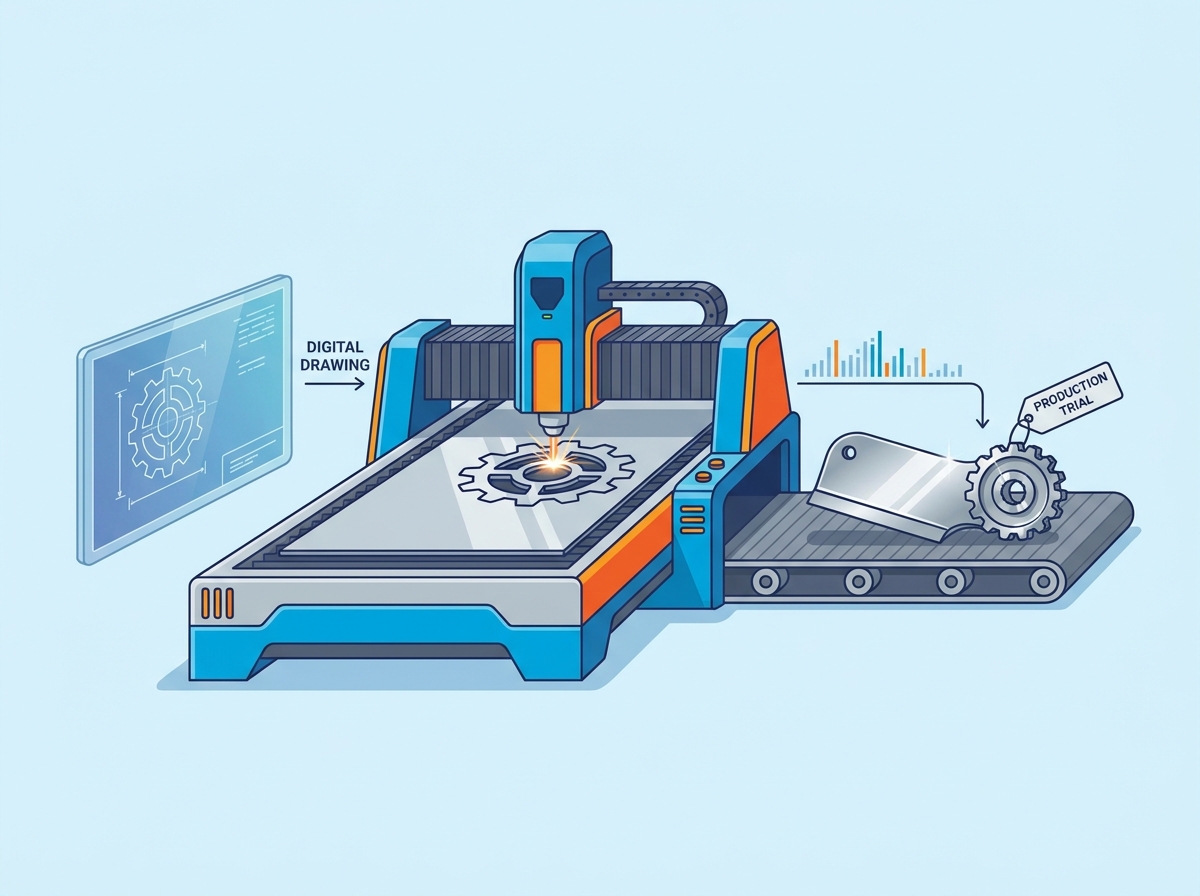
The evaluation begins strictly with file import and bottleneck identification. You outline the exact process of importing proprietary CAD files into the system. This step highlights potential cutting bottlenecks very early in the process. Sharp internal corners on thick plates often cause localized melting issues. Intricate geometries might require specialized, low-frequency piercing routines. Identifying these physical challenges upfront prevents wasted material and lost time later. Simulation metrics provide a data-driven baseline for evaluation.
CAM software simulates the entire cut virtually on a computer. It generates highly accurate estimates for cycle times and pierce durations. It also calculates projected assist gas consumption accurately based on material thickness. By running these simulations, engineering teams can tweak part designs slightly to make them more manufacturable before a single sheet of metal is ever loaded onto the machine. Adjusting a corner radius by just a few millimeters can sometimes shave minutes off a complex cutting program.
Relying solely on glossy manufacturer brochures is insufficient for capital equipment decisions. Specifications printed on paper do not always match real-world factory performance. You need tangible, physical proof before committing massive financial resources. Structuring the request properly ensures accurate, reliable validation. Submit real, complex production files instead of generic test shapes. Specify the exact material grades and thicknesses used in your facility. Define your acceptable tolerance deviations clearly to the vendor.
Utilizing sample cutting support provides this critical physical evidence. Once samples arrive, implement a strict, uncompromising inspection protocol. Check for microscopic dross accumulation along the bottom edge. Look for excessive striation marks on thick cuts. Analyze the HAZ for metallurgical changes that could compromise field durability. Measure the cut parts with digital calipers to verify that kerf compensation was applied correctly. If the parts require heavy grinding before they fit into your welding fixtures, the machine parameters need adjustment.
A successful sample cut leads directly to a full batch testing phase. Run a continuous, multi-hour batch trial to test overall machine stability. This evaluates chiller performance and thermal management over extended operating periods. Heavy cutting generates massive heat that the system must dissipate continuously. Real-time metric validation compares actual trial data against Phase 1 simulations. Monitor the true cut time for a full, complex nest of parts.
Track the actual gas usage during continuous, heavy-duty operation. Note the exact frequency of required operator interventions or machine pauses. This hard data proves whether the machine truly meets your production demands. If the machine requires constant focal point adjustments or nozzle cleanings during the trial, it will likely struggle to maintain pace in a real-world, high-volume agricultural manufacturing environment. A reliable machine should run through an entire shift with minimal operator input once the program starts.
Installing heavy industrial equipment requires careful, proactive facility planning. Power and gas logistics present significant operational risks. High-power lasers demand exceptional, uninterrupted power grid stability. Minor voltage fluctuations can interrupt cuts and damage sensitive optical components. You must also plan for high-volume assist gas delivery systems. Nitrogen, oxygen, or compressed air require robust plumbing and bulk storage solutions. If you plan to use shop air for cutting, you must install refrigerated dryers and coalescing filters to remove all moisture and oil, which will instantly destroy the laser optics.
Foundation and footprint requirements demand immediate engineering attention. Large machines consume massive amounts of premium factory floor space. Reinforced foundation load-bearing capacities are almost always necessary. The concrete must support heavy-duty cutting systems and towering automation storage units without shifting. A minimum of a 6-inch to 8-inch reinforced concrete slab is standard. Vibration isolation pads are frequently required to prevent heavy forklift traffic from disrupting the laser's microscopic optical alignment during cutting operations.
The learning curve for advanced equipment can cause temporary production bottlenecks. Transitioning veteran staff to advanced CNC controls takes time and patience. Sophisticated nesting software requires specialized computer skills and spatial awareness. Operators must understand complex laser parameters and unpredictable material behaviors. They are no longer just running a machine; they are managing a digital manufacturing workflow. Mitigate costly downtime by establishing strict Standard Operating Procedures (SOPs).
Document the exact, step-by-step process for daily lens cleaning. Create visual guides for precise nozzle centering and focal point adjustment. Enforce routine preventive maintenance schedules strictly and without exception. Well-trained operators keep the machine running safely at peak efficiency. Cross-training multiple employees ensures that production does not halt if the primary machine operator is absent. Operators should also be trained to recognize the sound of a bad cut, allowing them to pause the machine before an entire sheet of expensive material is ruined.
Evaluate the massive upfront investment against long-term operational savings. High-power laser sources require significant initial capital to acquire. They achieve drastically faster cutting speeds than legacy equipment. They also eliminate costly secondary processing like grinding, milling, and deburring. These operational savings accumulate rapidly over multiple busy shifts. Calculating the true cost per part requires comprehensive, accurate data.
Factor in the specific lifespan of essential cutting consumables. Nozzles, protective windows, and ceramics need regular, scheduled replacement. Account for hourly electrical energy consumption and bulk assist gas volume. This rigorous framework reveals the genuine mechanical efficiency of the equipment. Faster cutting speeds mean more parts produced per hour, which directly dilutes the fixed overhead costs across a larger volume of finished agricultural components. When you eliminate the grinding department entirely, the labor savings alone often justify the equipment upgrade.
Your manufacturing needs will evolve rapidly as your business grows. Automation readiness determines the long-term operational viability of the machine. Evaluate the system's underlying architecture for compatibility with future upgrades. Can you seamlessly add robotic part sorting later? Does the physical layout accommodate automated guided vehicles (AGVs)? Multi-tower storage systems can feed the machine autonomously as production scales upward.
Future-proofing your factory layout prevents costly relocations and premature equipment replacements down the road. Investing in a machine with an open software architecture allows it to integrate smoothly with your facility's Enterprise Resource Planning (ERP) systems. This streamlines the flow of data from the front office directly to the factory floor, ensuring that material inventory and production schedules remain perfectly synchronized without manual data entry.
Compile a portfolio of your most challenging part drawings and CAD files.
Define your exact material specifications, including thickness and alloy grades.
Initiate a formal request for physical test cuts with your shortlisted vendors.
Establish a strict internal inspection protocol for evaluating edge quality and thermal distortion.
Schedule an extended batch trial to validate continuous operational stability.
A: Efficiently piercing and cutting 15mm to 25mm carbon steel typically requires a fiber laser with 10kW of power or higher. High-kilowatt systems penetrate heavy plates rapidly, minimizing thermal distortion and ensuring clean edges. Lower power systems struggle with these thicknesses, resulting in slower speeds and excessive dross.
A: It provides physical proof of machine capabilities before capital commitment. By testing your actual production files on specific material grades, you validate edge quality, cycle times, and thermal distortion limits. This hands-on evidence ensures the machine meets your strict manufacturing tolerances.
A: Yes, fiber lasers excel at processing high-strength alloys like Hardox and HSLA steels. Success depends heavily on proper assist gas selection and precise focal point adjustments. Nitrogen is often used to prevent oxidation, ensuring the cut edges remain strong and ready for immediate welding.
A: Standard flatbed machines process only sheet metal. However, hybrid machines feature rotary attachments designed specifically for structural tubes. While hybrids save floor space, high-volume production of Roll-Over Protection Structures (ROPS) often benefits from a dedicated tube laser cutter for maximum throughput.
A: The return on investment timeline varies based on shift volume and operational efficiency. Key variables include the reduction of outsourced cutting costs and the elimination of secondary deburring operations. Running the machine across multiple shifts significantly accelerates the return by maximizing daily part output.
A: Automated shuttle tables and sheet loaders drastically reduce machine idle time. They swap heavy-gauge sheets in seconds, keeping the laser cutting continuously. Furthermore, automation provides major safety benefits by eliminating the need for operators to maneuver heavy plates with manual cranes.


