


Views: 0 Author: Site Editor Publish Time: 2026-10-30 Origin: Site


Powder coating failures on fabricated steel parts rarely originate in the curing oven. They typically begin at the cutting stage. Unprepared laser-cut edges remain a primary cause of coating delamination, corrosion creep, and rejected batches. Parts cut by a standard CNC steel laser cutting machine develop localized metallurgical changes. Specifically, you will find oxide scale, dross accumulation, and razor-sharp external edge radii. These conditions actively repel or destabilize powder coat adhesion.
Mitigating these risks requires a systematic approach to edge preparation. You must balance upstream cutting parameters with downstream mechanical or chemical treatments. This guide breaks down how to evaluate edge quality and select the right preparation methods based on part geometry. You will learn actionable strategies to eliminate finishing bottlenecks and ensure long-lasting powder coat adhesion.
Oxide Scale is a False Substrate: Cutting steel with oxygen assist gas creates a friable iron oxide layer that powder coatings will bond to, but the layer itself will eventually detach from the base metal, causing catastrophic finish failure.
Edge Radiusing is Non-Negotiable: Sharp, 90-degree laser-cut edges cause powder to pull away during curing (the Faraday cage effect and surface tension), resulting in low film build and premature rusting.
Upstream Gas Selection Dictates Downstream Prep: Switching laser cutting assist gases from oxygen to nitrogen eliminates the oxide layer, shifting costs from manual downstream grinding to upstream gas consumption.
Geometry Dictates the Preparation Method: Choosing between manual sanding, automated tumbling, abrasive blasting, or chemical pickling depends heavily on part volume, whether the parts are flat or formed, and environmental compliance capabilities.
Edge Prep Does Not Replace Pre-Treatment: Even perfectly descaled and radiused edges require thorough chemical washing and degreasing to ensure the final finish bonds properly.
A coating-ready edge demands specific criteria to ensure long-term performance. It needs a distinct surface profile or anchor pattern to grip the polymer. It requires zero friable scale and a minimum edge radius. The surface must also remain entirely free of cutting fluids and thermal residue. Achieving these criteria directly depends on how the equipment processes the raw material. Operators often overlook the connection between the laser parameters and the final paint line yield.
Thermal dynamics create a distinct Heat-Affected Zone (HAZ) along the cut path. Rapid heating and subsequent cooling alter the localized microstructure of the steel. This thermal shock changes the hardness and porosity of the immediate edge. When processing mild steel with oxygen, high temperatures trigger a violent exothermic reaction. This interaction creates a bluish-black oxide scale directly on the cut face.
This scale is an iron oxide compound. It differs chemically and physically from the base steel substrate. The oxide layer is brittle, smooth, and highly resistant to standard chemical washes. It forms a distinct barrier between the raw steel core and the outside environment. Understanding this anatomy helps diagnose downstream finishing failures. For example, a 0.25-inch mild steel plate cut with oxygen will develop a scale layer thick enough to block standard iron phosphate pre-treatments from etching the actual steel.
Sharp edges cause a severe low film build phenomenon during application and curing. During the baking process, surface tension pulls the melting powder away from near-zero external edge radii. Additionally, the Faraday cage effect repels electrostatically charged powder particles from sharp corners. This leaves the most vulnerable part of the steel with the thinnest layer of protection, inviting rapid corrosion.
The oxide layer presents a massive structural weakness. Powder coatings actually adhere quite tightly to the oxide scale. However, the scale itself bonds weakly to the underlying steel. Mechanical stress, impact, or thermal cycling easily fractures this weak bond. When the oxide layer flakes off, it takes the powder coating with it in large sheets.
Dross, or slag, acts as a physical barrier that compounds these issues. It traps airborne contaminants and shop dust. Dross prevents uniform electrostatic powder attraction across the bottom edge of the part. It also disrupts the pre-treatment wash cycle by harboring oils and cutting fluids in microscopic crevices, leading to outgassing pinholes during curing.
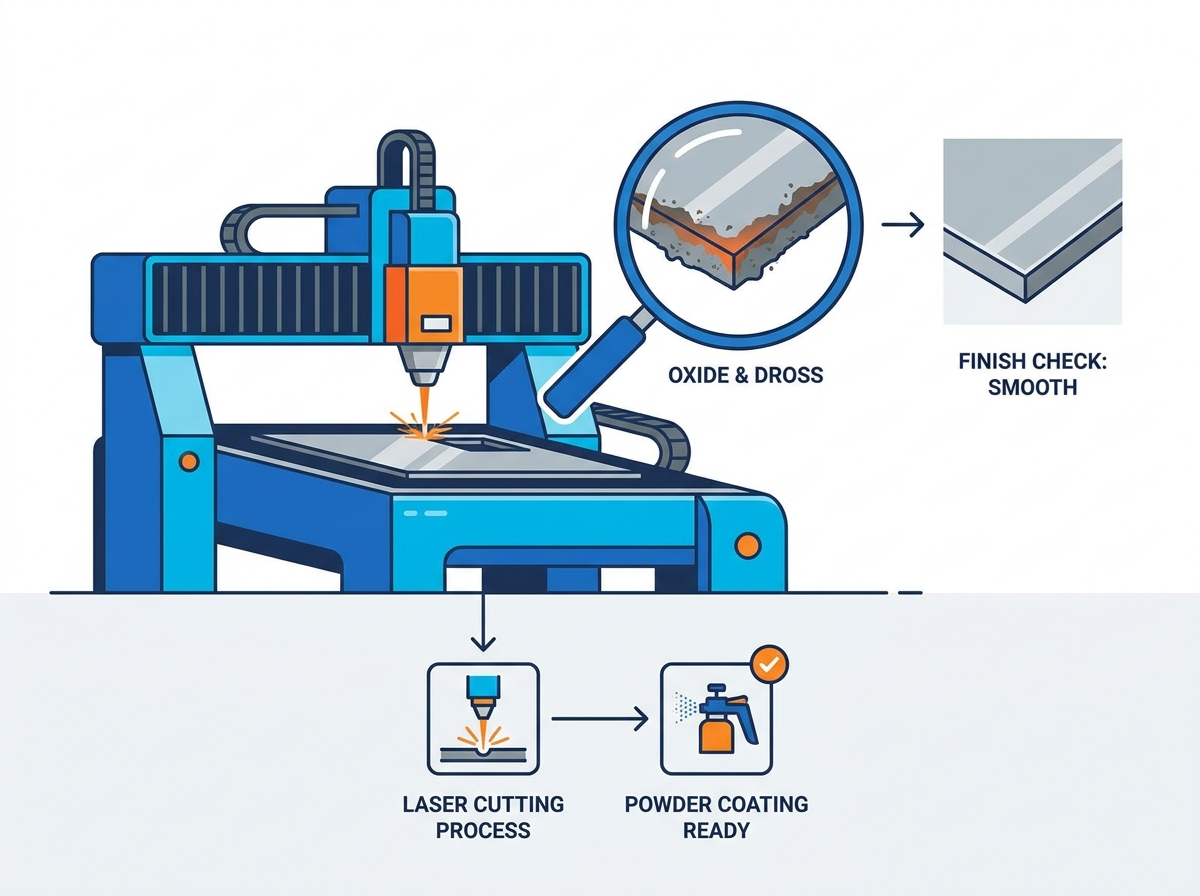
Establish a standardized quality assurance framework to catch defects early. Inspect parts immediately after they leave the cutting bed. Proper laser cut quality evaluation ensures accurate identification of surface anomalies before parts reach the finishing department. Catching these issues upstream saves significant rework labor.
Test scale integrity using cross-hatch adhesion tests on raw edges. You can also perform aggressive tape pull tests directly on the cut face following ASTM D3359 standards. If the tape pulls away black flakes, the edge will fail in the field. Look for visual and tactile indicators during routine inspection.
A thick, flaky, or excessively dark bluish-black layer signals problematic oxide. This requires aggressive mechanical or chemical removal. Conversely, a tight, straw-colored edge might indicate a cleaner cut, but it still requires verification. Never assume an edge is coating-ready based purely on a smooth visual appearance. Operators should scrape the edge with a hardened steel scribe. If the scribe digs in and chips the surface, the scale is too thick.
Categorize dross severity to determine the required downstream intervention. Easy-to-remove powder dross often wipes away with a gloved hand or a light file. Hard, welded-on slag requires heavy mechanical chipping, grinding, or tumbling. Identifying the dross type dictates the labor allocation for the shift.
Understand the root causes of these formations. Incorrect feed rates, focal point issues, and improper gas pressure directly contribute to burr and slag formation. If operators notice increasing dross on a specific nest, they must adjust the cutting parameters immediately rather than passing the burden to the grinding department. A nozzle standoff distance that is too high often introduces turbulence, leading to heavy bottom-edge dross.
Industry standards dictate specific edge radiusing prior to powder coating applications. Most architectural and automotive specifications require a minimum radius of 0.5mm to 1.0mm. This rounded profile ensures the powder wraps continuously around the edge, maintaining uniform thickness and preventing premature rust.
Verify edge profiles on the shop floor using precise measurement tools. Radius gauges provide quick, objective go/no-go checks for operators. For high-precision components, optical comparators offer exact profile verification. Consistent radiusing is just as critical as oxide removal for long-term coating durability.
Altering machine parameters can bypass downstream preparation entirely. Selecting the right laser cutting assist gases represents the most effective upstream approach to surface management. Gas choice dictates the chemical reaction at the cut zone, fundamentally changing the resulting edge condition.
Oxygen creates a violent exothermic reaction when it contacts molten steel. This reaction increases cutting speed significantly, especially in thick mild steel plates. The added heat from the burning iron allows the machine to slice through heavy gauges rapidly. This makes oxygen the default choice for pure cutting throughput.
The primary drawback is the inevitable formation of heavy oxide scale. This scale guarantees the need for aggressive mechanical or chemical removal before coating. You trade cutting speed for downstream labor. If your facility lacks automated deburring equipment, the manual grinding hours will quickly erase the time saved during the cutting process.
Nitrogen provides an inert cutting environment. It physically blows away molten metal using high pressure, often exceeding 15 bar, without triggering oxidation. This results in a bright, clean cut face devoid of the friable black scale. The edge retains the exact metallurgical properties of the parent steel.
The benefit is immediate finishing readiness. Parts are often ready for standard pre-treatment and coating immediately after cutting, assuming the parameters remain dross-free. However, nitrogen cutting requires significantly higher gas pressure and volume. It also demands higher wattage from the laser source, such as upgrading from a 4kW to a 10kW fiber laser, to maintain acceptable speeds in thicker materials.
Calculate the true cost of an oxygen-cut part to make an informed operational decision. Combine the machine cutting time, the manual grinding labor rate, and the cost of abrasive consumables. Factor in the scrap rate from over-grinding or delayed coating failures.
Compare this directly to a nitrogen-cut part. Factor in the higher bulk gas costs and potentially slower cutting speeds on older machines. Weigh these expenses against the benefit of zero downstream prep labor. In most high-volume scenarios, the elimination of manual grinding makes nitrogen cutting highly profitable despite the increased gas consumption.
When upstream optimization isn't feasible, you must rely on downstream approaches. Detailed methods exist to remove oxide and dross effectively. Selecting the right method depends on your facility's footprint, environmental permits, and part volume.
Chipping and deslagging involve manual or pneumatic tools. Use these to remove heavy, welded-on dross before attempting fine finishing. This is a roughing process meant to clear the path for abrasives. Skipping this step destroys sanding belts and grinding wheels prematurely.
Manual grinding and sanding carry high labor costs and ergonomic risks. They produce inconsistent edge radiusing depending on operator fatigue. They also introduce the risk of over-machining critical dimensions on precision parts. Vibratory tumbling and deburring machines offer a superior alternative for small-to-medium parts.
Tumbling provides excellent edge radiusing across complex geometries.
It removes light dross efficiently without manual intervention.
Ceramic media breaks down sharp edges uniformly.
However, tumbling is less effective on heavy, stubborn oxide scale.
Evaluate different media for oxide removal based on the required finish. Sand, G40 steel grit, and glass bead blasting each offer distinct aggression levels. Blasting aggressively strips the oxide layer while simultaneously texturing the base steel. This creates an ideal anchor profile for polymer adhesion.
Achieving a white metal or near-white metal blast finish significantly enhances powder grip. Blasting easily reaches into internal cutouts and complex geometries that grinders cannot touch. However, blasting cabinets require significant compressed air resources and regular media maintenance to remain effective.
Acid baths, such as hydrochloric or sulfuric acid, dissolve oxide scale uniformly. This chemical approach is highly effective across complex, three-dimensional geometries. Pickling strips the scale without altering the dimensional tolerances of the raw steel part.
Implementation carries substantial operational risks. You must manage strict environmental compliance and hazardous waste disposal protocols. There is also a severe risk of flash rusting. Parts must be immediately neutralized, rinsed, and dried after pickling, or surface rust will form within minutes.
Handheld or automated fiber lasers ablate oxide scale instantly. They use high-intensity light pulses to vaporize the contaminant without altering the base metal geometry. This process generates no secondary waste, requires no consumables, and leaves a perfectly clean steel surface.
This technology offers excellent scalability for modern fabricators. You can integrate robotic laser cleaning cells directly into existing fabrication lines. While the initial capital expenditure is high, the operating costs are exceptionally low compared to abrasive blasting or chemical pickling.
Mechanical edge prep is never the final step before the spray booth. You absolutely must remove abrasive dust, residual cutting oils, and shop carbon. Applying powder over grinding dust guarantees poor adhesion and a gritty final texture.
Integrate iron phosphate or zirconium washes immediately post-edge prep. These chemical conversion coatings ensure the final finish bonds properly to the bare steel. They provide a microscopic crystalline layer that grips the powder and inhibits under-film corrosion if the coating is scratched.
Comparison of Downstream Edge Preparation Methods
Preparation Method | Oxide Removal Effectiveness | Edge Radiusing Capability | Best Suited For | Primary Drawback |
|---|---|---|---|---|
Manual Grinding | High | Inconsistent | Low-volume, large parts | High labor cost, ergonomic risks |
Automated Tumbling | Low to Medium | Excellent | High-volume, small parts | Ineffective on heavy oxide scale |
Abrasive Blasting | High | Moderate | Complex geometries, 3D parts | High compressed air demand |
Chemical Pickling | Excellent | None | Intricate parts, internal cutouts | Hazardous waste management |
Laser Cleaning | Excellent | None | Precision parts, automated lines | High initial equipment cost |
Choosing the right combination of technologies depends on operational scale and part geometry. You must balance conceptual trade-offs to maximize return on investment. A localized bottleneck in finishing can easily negate the speed advantages of modern laser cutting equipment.
Use a decision matrix to evaluate capital expenditures. Determine when to upgrade to a high-power fiber laser capable of nitrogen-cutting thick steel. Compare this against investing in automated deburring or blasting equipment for your existing oxygen-cut parts.
If your product mix consists primarily of thin-gauge mild steel, switching to nitrogen is often the most cost-effective route. If you routinely process thick plates where nitrogen cutting is prohibitively slow, investing in an automated pass-through deburring machine yields the best long-term ROI.
Flat parts show high suitability for pass-through automated brush and belt deburring machines. These machines strip oxide and radius the edges in a single pass. They offer massive throughput advantages for two-dimensional profiles.
Formed or complex parts require entirely different 3D solutions. Abrasive blasting cabinets, chemical dip tanks, or robotic laser cleaning cells work best here. Calculate throughput accurately in pieces per hour. Identify physical bottlenecks where manual handling or fixture loading slows down automated processing.
Incomplete oxide removal poses a massive financial risk. It leads directly to delayed coating failures in the field, triggering warranty claims and damaging brand reputation. Operators often miss localized patches of scale on internal cutouts or tight corners.
Mitigate this by implementing strict, documented evaluation protocols. Perform regular cross-hatch adhesion testing on finished sample coupons to verify process stability. Train quality control personnel to identify the visual difference between bare steel and polished oxide scale.
Audit your current coating reject rates to identify failure patterns directly linked to edge quality and oxide flaking.
Calculate the localized labor costs of manual edge grinding per shift to establish a baseline for equipment ROI.
Run a direct cost-comparison test between oxygen and nitrogen cutting on your specific machinery using your most common part nests.
Implement a standardized radius gauge check for all parts entering the finishing department to ensure proper edge rounding.
Verify your chemical wash stage is adequately removing all abrasive dust generated by mechanical edge preparation.
A: Powder coating peels because it bonds to the friable iron oxide layer created during oxygen laser cutting, rather than the base steel. Under mechanical stress or thermal cycling, this brittle oxide layer detaches, taking the coating with it. Additionally, sharp 90-degree corners prevent adequate film build due to the Faraday cage effect and surface tension during curing.
A: You can often powder coat directly over nitrogen-cut steel after a standard chemical wash, as it lacks an oxide layer. However, oxygen-cut steel strictly requires mechanical or chemical oxide removal first. Coating directly over oxygen-cut edges guarantees long-term adhesion failure.
A: The best method depends on part geometry. Abrasive blasting is excellent for complex 3D parts, while automated brush deburring machines are highly efficient for high-volume flat parts. Laser cleaning is rapidly emerging as the most precise and scalable method for targeted oxide removal without altering dimensions.
A: No. Oxide formation only occurs when cutting with oxygen as an assist gas or when using compressed shop air containing oxygen. Utilizing high-pressure nitrogen or argon as an assist gas creates an inert environment that completely prevents oxidation on the cut face.
A: Industry standards generally recommend a minimum edge radius of 0.5mm to 1.0mm. This rounded profile prevents the melting powder from pulling back during the thermal curing process, ensuring adequate film thickness and robust edge protection against corrosion.
A: Chemical pickling provides uniform scale removal, making it superior for formed or complex parts where grinders cannot reach. However, it involves significant environmental and safety overhead. Mechanical grinding is often preferred for simpler parts as it simultaneously rounds sharp edges while removing scale.
A: Yes. Standard chemical pre-treatment and degreasing remain mandatory. Washing removes fine grinding dust, residual cutting fluids, and shop contaminants, ensuring the bare steel is perfectly clean before powder application.


