


Views: 0 Author: Site Editor Publish Time: 2026-10-19 Origin: Site


Industrial surface preparation is shifting from abrasive media blasting and chemical stripping to laser ablation. Stringent environmental regulations and the demand for repeatable quality drive this change. Traditional methods generate massive secondary waste and pose respiratory hazards. Laser technology eliminates these issues by vaporizing contaminants directly from the substrate. Selecting the wrong laser emission type—Continuous Wave (CW) or Pulsed—results in severe substrate damage through thermal distortion or crippling operational bottlenecks due to inadequate throughput. Navigating the technical divide between CW and pulsed systems requires aligning laser physics with specific production realities. You cannot simply purchase the highest wattage available and expect optimal results across all materials. This guide breaks down the operational trade-offs, heat management profiles, and evaluation criteria necessary to specify the correct laser cleaning technology for heavy-duty rust and precision coating removal.
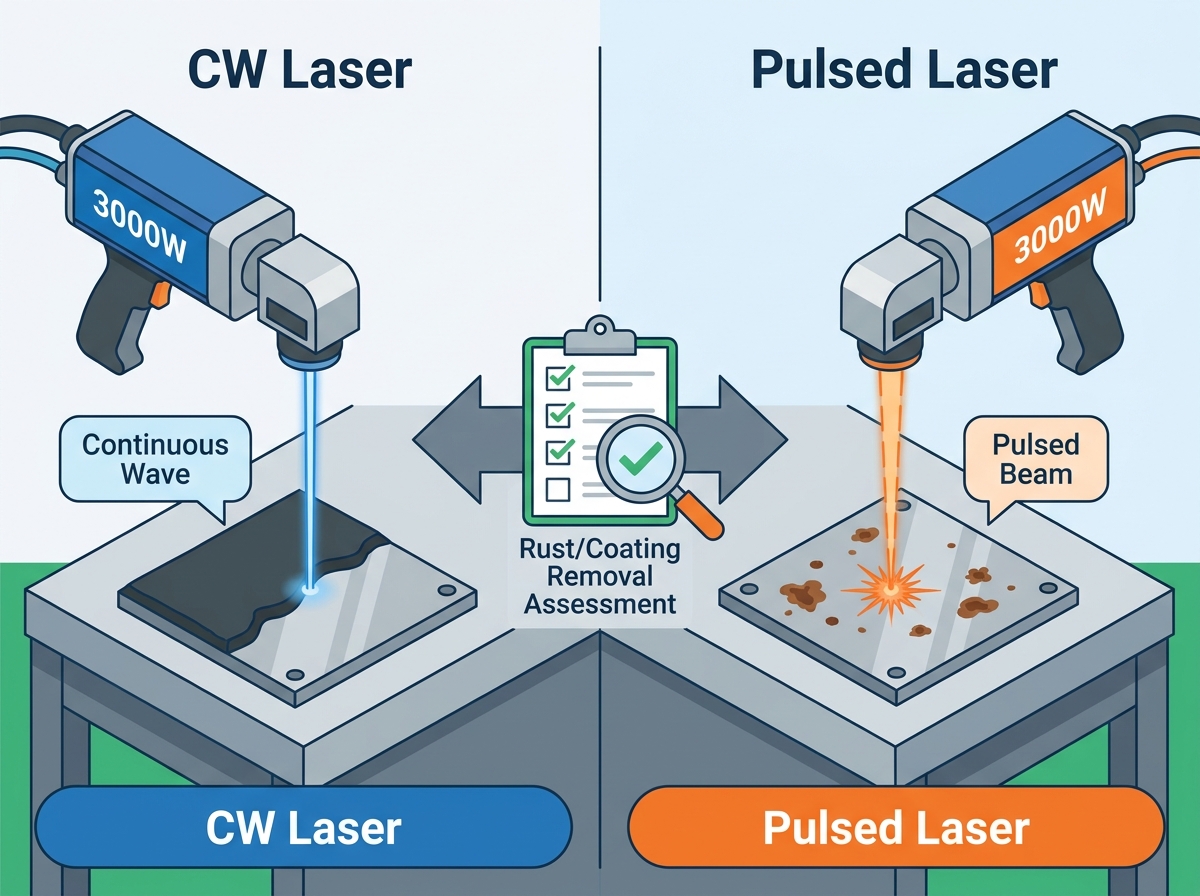
Throughput vs. Precision: CW lasers excel in high-speed, large-area removal of thick rust and heavy industrial coatings, whereas pulsed lasers are mandatory for precision cleaning, thin oxides, and localized contamination on heat-sensitive substrates.
The High-Power Standard: A 3000W handheld laser cleaning machine represents the upper tier of CW throughput, ideal for structural steel and heavy equipment, but requires strict thermal management protocols.
Substrate Integrity & Thermoregulation: Pulsed lasers utilize high peak power with short durations to break chemical bonds with minimal thermal transfer, offering superior thermoregulation and practically eliminating the Heat-Affected Zone (HAZ).
Empirical Validation: Procurement decisions should never rely solely on spec sheets; a structured laser cleaning sample assessment is a non-negotiable step in the technical evaluation process to verify surface effects and cycle times.
Before evaluating specific laser architectures, facility managers and production engineers must define the exact success criteria for their surface preparation tasks. Laser ablation is a highly tunable process. Understanding the physical and chemical constraints of your specific application prevents catastrophic damage to base materials and ensures production targets are met.
Establish the maximum allowable heat input before the base material experiences metallurgical changes, warping, or micro-cracking. Every alloy has a specific thermal threshold. Applying excessive continuous heat to thin-gauge 6061 aluminum causes rapid warping and alters its temper. High-carbon steels like 4140 might experience localized hardening or embrittlement if the cooling rate after laser exposure is too rapid. You must determine how much thermal energy the substrate can absorb and dissipate safely. Thick cast iron engine blocks act as massive heat sinks. They tolerate aggressive thermal loads easily. Thin aerospace panels require strict temperature control to maintain flight-worthy certifications.
Categorize the target material and its required ablation threshold. Contaminants react differently to laser energy based on their color, chemical composition, and thickness. Flash rust requires minimal energy to vaporize. Heavy mill scale demands sustained power to break its bond with the base steel. Organic compounds like epoxy coatings and polyurethane paints absorb specific wavelengths of light. They often require high-power continuous delivery to burn through layers exceeding 20 mils. Military applications often involve Chemical Agent Resistant Coatings (CARC), which are notoriously difficult to remove and produce hazardous dust when sanded. Laser ablation captures these hazards through integrated fume extraction. Marine anti-fouling paints contain heavy metals that require careful containment during removal. Profiling the contaminant dictates whether you need raw thermal power or precise shockwave ablation.
Define the required square footage per hour to maintain or exceed current production line speeds. If you are replacing a massive sandblasting booth processing structural steel beams, your primary metric is raw speed. The laser system must match the throughput of abrasive blasting to remain viable. If you are cleaning delicate injection molds, cycle time might be secondary. Preserving the dimensional accuracy of the mold surface takes priority. To accurately calculate your baseline throughput, follow these steps:
Measure the total square footage of the parts processed in a standard shift.
Record the exact time spent actively blasting or stripping, excluding setup and teardown.
Factor in the time spent on secondary operations, such as masking, media cleanup, and waste disposal.
Divide the total square footage by the active processing time to establish your true square-footage-per-hour requirement.
Determine the required condition of the surface after cleaning. Does the surface require a specific roughness profile for subsequent coating adhesion? Some laser parameters leave a micro-textured surface that promotes paint bonding. Is a micro-oxidation layer acceptable, or do you need a completely bare-metal finish? In some aerospace applications, a completely non-destructive clean is required. The laser must remove the coating without altering the microscopic topography of the substrate. Defining these end-state requirements narrows down the choice between continuous and pulsed delivery.
Continuous Wave (CW) lasers represent the brute force approach to industrial surface preparation. They deliver maximum thermal energy over large surface areas. This makes them the primary choice for heavy industrial applications where substrate thickness mitigates the risk of heat damage.
CW lasers deliver an uninterrupted beam of energy. They rely on rapid thermal accumulation to burn, melt, or vaporize surface contaminants. Pulsed systems turn on and off millions of times per second. A CW laser remains constantly active while the trigger is engaged. This continuous delivery creates a sustained heat pool on the surface. The laser energy is absorbed by the rust or coating, rapidly raising its temperature until it transitions into a gas or plasma state. This thermal mechanism works exceptionally well for thick, resilient materials requiring sustained energy to break down.
The raw power of CW lasers makes them indispensable for heavy-duty tasks. Common applications include:
Structural steel preparation prior to welding or coating.
Bridge and heavy-duty infrastructure maintenance.
Pipeline descaling in the oil and gas sector.
Ship hull stripping in marine environments.
Removal of thick, resilient industrial coatings where the base metal is thick enough to prevent warping.
The primary drawback of CW technology is heat management. There is a high risk of thermal distortion on thin sheet metal, typically anything under 3mm thick. The continuous heat easily warps thin panels, rendering them unusable. CW lasers also have the potential to alter the temper or hardness of precision-machined components. Operators have less control over the exact depth of removal and residual surface effects compared to pulsed systems. If the laser dwells on a single spot for a fraction of a second too long, it begins melting the base metal.
When evaluating high-throughput solutions, a 3000W handheld laser cleaning machine has become the standard for replacing heavy sandblasting operations. This power class offers maximum square-footage-per-hour yields for heavy-duty cleaning tasks. The sheer volume of energy allows operators to strip thick epoxy and heavy marine rust at speeds that rival or exceed traditional abrasive methods.
Managing a high-power optical head introduces ergonomic challenges. The handpiece must accommodate robust water-cooling channels to handle the 3000W output, increasing its weight. Addressing operator fatigue requires mechanized assist devices, tool balancers, or integrating the cleaning head onto a robotic arm for sustained shifts. To prevent localized substrate melting, these 3000W systems utilize oscillating beam patterns, commonly known as wobble heads. The wobble head rapidly moves the focused laser beam in a line, circle, or figure-eight pattern. This distributes the massive thermal load over a wider area, preventing the beam from dwelling on a single microscopic point and causing severe substrate damage.
While CW lasers provide raw speed, pulsed lasers offer surgical precision. They are designed for applications where preserving the exact metallurgical state and dimensional accuracy of the substrate is the highest priority.
Pulsed lasers emit energy in ultra-short bursts, typically measured in nanoseconds. While the average power might be relatively low, the peak power of each individual pulse can reach megawatts. This massive peak power strips contaminants via photothermal and photomechanical shockwaves. The rapid pulse hits the surface, causing the contaminant to instantly sublimate and expand. This rapid expansion creates a micro-shockwave that blasts the surrounding contamination away from the substrate. Because the pulse duration is incredibly short, the heat does not have time to conduct deep into the base metal. This provides excellent thermoregulation without transferring sustained heat to the substrate.
The precision and low heat input of pulsed lasers make them ideal for sensitive applications, including:
Aerospace components where altering the alloy temper is strictly prohibited.
Injection mold cleaning to remove residue without rounding sharp edges or altering the mold texture.
Historical artifact restoration requiring delicate removal of oxidation.
Automotive engine parts where mating surfaces must remain perfectly flat.
Removal of thin oxides and localized contamination on sensitive, thin-walled alloys.
The main limitation of pulsed laser technology is processing speed. They are significantly slower for large-area, heavy-rust applications compared to CW lasers. Stripping a thick epoxy coating from a steel I-beam with a pulsed laser would be highly inefficient. Pulsed lasers require complex internal electronics to generate those high-peak-power nanosecond bursts. This requires more complex internal electronics and robust optical components compared to continuous wave systems.
As the industry seeks to combine the speed of CW with the precision of pulsed lasers, hybrid systems are beginning to emerge. These systems attempt to bridge the gap between heavy ablation and delicate surface finishing.
Hybrid systems combine a CW beam and a pulsed beam working together or in sequence. The CW energy is typically used to preheat and soften thick coating layers. This thermal softening makes the coating more susceptible to ablation. Immediately following the CW exposure, the pulsed beam assists in the final, precise removal of the softened material. This dual-action approach aims to achieve high removal rates on thick coatings while utilizing the pulsed beam to protect the underlying substrate from excessive thermal damage during the final pass.
Evaluate the maturity of hybrid systems carefully. While they are promising for complex multi-layer coatings, they introduce higher maintenance complexity. Aligning two distinct laser sources and managing the optics for both wavelengths requires sophisticated engineering. They carry higher adoption risks compared to established single-source systems. For most industrial applications today, selecting a dedicated high-power CW system or a dedicated pulsed system remains the most reliable and straightforward approach.
Selecting the right equipment requires a direct comparison of laser specifications against your facility's operational realities. You must balance heat input, production speed, and infrastructure capabilities.
Compare the continuous thermal load of CW against the superior thermoregulation of pulsed lasers. Pulsed lasers allow for thermal relaxation time—the microscopic pause between pulses where the material can dissipate heat. CW lasers offer no relaxation time. If a CW laser is moved too slowly across high-carbon steel, it can cause localized annealing or hardening, altering the mechanical properties of the part. Pulsed lasers practically eliminate this risk by keeping the bulk temperature of the part near ambient levels.
Analyze the fundamental trade-off. CW provides raw speed for heavy-duty tasks but leaves a thermally affected microscopic profile. It may create a slight surface melt or oxidation layer. Pulsed provides a pristine, factory-original finish for sensitive parts but at a fraction of the speed for thick contaminants. You must decide if you are preparing a surface for a heavy industrial coating where a slightly rough, thermally affected surface is acceptable, or if you are cleaning a precision mold where any alteration to the surface finish is a failure.
Assess your facility infrastructure requirements. High-power systems demand robust electrical and cooling support. A 3000W CW system typically requires 480V 3-phase power, whereas lower-wattage pulsed units might operate on standard 220V single-phase power. Evaluate chiller requirements. High-power CW lasers generate significant internal heat and require large, heavy industrial chillers filled with distilled water or specific coolants. This impacts portability. Ambient operating temperature limits also vary. Running a high-power system in a non-climate-controlled facility during summer requires a significantly oversized chiller to prevent thermal faults.
Feature | Continuous Wave (CW) Laser | Pulsed Laser |
|---|---|---|
Throughput Speed | Extremely high for thick rust and coatings. | Slower; best for thin layers and localized areas. |
Heat Management | High thermal transfer; risk of distortion on thin metals. | Excellent thermoregulation; minimal heat transfer. |
Ideal Applications | Structural steel, bridges, ship hulls, heavy machinery. | Aerospace, injection molds, historical artifacts, thin alloys. |
Surface Finish | May leave a micro-textured or slightly oxidized surface. | Pristine, non-destructive, factory-original finish. |
Contaminant Type | Thickness | Recommended Laser Technology |
|---|---|---|
Flash Rust / Light Oxidation | < 0.5 mils | Pulsed Laser (High speed, no base damage) |
Heavy Mill Scale | > 2 mils | Continuous Wave (CW) Laser |
Marine Epoxy / Polyurethane | 10 - 30 mils | High-Power CW Laser (e.g., 3000W) |
Injection Mold Release Agents | Micron level | Pulsed Laser (Preserves mold texture) |
Aerospace Primer | 1 - 2 mils | Pulsed Laser (Prevents alloy temper changes) |
Theoretical ablation rates rarely match real-world factory conditions due to contaminant variability, underlying material heat sinks, and operator technique. Physical validation is required.
Every industrial coating and rust formation is unique. The exact chemical composition of a 20-year-old marine epoxy will react differently to laser light than a fresh powder coat. The thickness and thermal conductivity of the base metal act as a heat sink, changing how the laser energy accumulates on the surface. Because of these variables, you cannot accurately predict cycle times or surface effects without testing the specific laser on your actual parts.
Define the protocol for a rigorous laser cleaning sample assessment. Start by selecting careful trial pieces of representative parts that feature the worst-case-scenario contamination. Do not send clean, flat plates with a thin layer of spray paint. Send the heavy, complex geometry parts covered in the exact grime you need to remove. Establish baseline metrics for your current cleaning method. During the assessment, the manufacturer should test multiple focal lengths, scan speeds, and power levels to find the optimal parameters for your specific material.
Once the samples are returned, instruct your quality control team to perform rigorous post-assessment analytics. Do not just look at the surface visually. Perform metallurgical cross-sections to check for micro-cracking or changes in grain structure. Use dye penetrant testing to ensure no surface fissures were created by thermal shock. Conduct adhesion pull-tests on the cleaned samples to verify that subsequent coatings will bond correctly to the laser-cleaned substrate. This data proves whether the laser process meets your engineering standards.
Integrating laser cleaning technology into a production environment requires addressing safety, maintenance, and operational workflows. Ignoring these factors leads to equipment downtime and safety violations.
Address the strict Class 4 laser safety requirements immediately. Both high-power CW and pulsed lasers are Class 4 devices. Direct or scattered radiation can cause instant, permanent eye damage and skin burns. Implementation requires light-tight enclosures if operated in a fixed cell. If operated manually, you must establish a controlled laser safety area with interlocks on all access doors. Specialized laser safety eyewear rated for the specific wavelength with an Optical Density (OD) of 6 or higher is mandatory for anyone in the vicinity.
While laser cleaners do not use abrasive media like sandblasting, they are not entirely maintenance-free. Focus on protective lens replacement frequency. The protective window on the laser head prevents ablated debris from damaging the expensive internal focusing optics. If operators do not clean this window regularly, debris will burn into the glass, destroying the lens and potentially causing thermal feedback that damages the fiber optic cable. Proper lens cleaning procedures involve using optical-grade swabs and spectroscopic-grade methanol or acetone. Wiping a dry lens with a standard rag will scratch the anti-reflective coating. Fiber optic cable care is also critical. Bending the cable past its minimum radius will snap the internal glass fibers. Regular chiller maintenance, including flushing the coolant and cleaning air filters, is required to prevent thermal shutdowns.
Manual handheld operation requires a learning curve. Maintaining a consistent focal distance and travel speed by hand requires practice. If an operator slows down, they risk overheating the substrate. If they move too fast, they leave contamination behind. Maintaining the correct focal length is critical. If the operator pulls the laser head too far back, the beam spot size increases, dropping the energy density below the ablation threshold. The laser will simply heat the part without cleaning it. Pushing too close shrinks the spot size, potentially gouging the metal. For high-volume, repeatable tasks, consider integrating the laser head onto a robotic arm or CNC gantry. Automation guarantees a repeatable standoff distance and consistent travel speed, ensuring uniform cleaning quality and removing operator fatigue from the equation.
To successfully transition your surface preparation workflow to laser ablation, execute the following steps:
Document your exact substrate materials, thicknesses, and the chemical composition of the contaminants you need to remove.
Calculate your required hourly throughput based on current production bottlenecks to establish a minimum speed baseline.
Select representative, worst-case-scenario parts from your production line for physical testing.
Contact a reputable laser manufacturer to schedule a formal sample assessment using both CW and pulsed technologies.
Analyze the returned samples using metallurgical cross-sections and adhesion pull-tests to verify substrate integrity before finalizing procurement.
A: Yes. If the continuous wave laser dwells too long on a single area, or if the base metal is too thin to dissipate the heat, it can cause warping, melting, or metallurgical changes. Proper parameter settings and constant movement are required to prevent damage.
A: Pulsed lasers remove material layer by layer at the micron level. The depth is highly controllable based on the pulse frequency, energy per pulse, and the number of passes. This makes it ideal for selective coating removal and localized contamination without affecting the base.
A: Generally, a 3000W CW laser is too aggressive for thin aluminum and risks severe thermal distortion. It should only be used on very thick aluminum substrates with rapid pass speeds. Pulsed lasers are heavily preferred for aluminum due to better thermoregulation.
A: Provide the manufacturer with exact production samples featuring the worst-case-scenario contamination. Include detailed specifications on the base material, the exact chemical makeup of the coating or rust, and your minimum acceptable cycle time for the cleaning process.
A: Yes, but powder coatings are highly resilient. A high-power CW laser is typically required to efficiently burn through thick powder coats. A pulsed laser may be too slow for high-volume powder coat removal due to the coating's thermal resistance.
A: Unlike sandblasting, laser cleaners do not use abrasive media. However, they do require periodic replacement of protective focal lenses, cover gases in some specific applications, and distilled water or specialized coolant for the industrial chiller system.


